
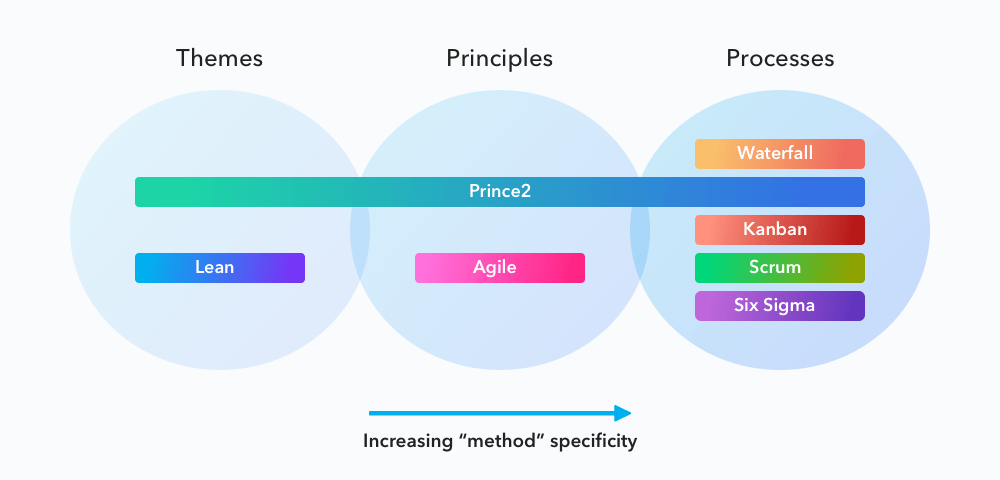
Project management methodologies are systematic approaches or frameworks that help organizations and project managers plan, execute, monitor, and control projects more effectively. Different methodologies are suited to different types of projects, and they provide guidelines, processes, and best practices to ensure successful project delivery. Here are some popular project management methodologies:
- Waterfall Methodology:
- Sequential Approach: Waterfall is a linear and sequential methodology where each phase must be completed before moving on to the next.
- Phases: Typically, it consists of phases such as requirements, design, implementation, testing, deployment, and maintenance.
- Documentation-Driven: Emphasizes thorough documentation at each phase.
- Agile Methodology:
- Iterative and Incremental: Agile divides a project into small increments with minimal planning, and work is done in short iterations.
- Flexibility: Emphasizes adaptability and collaboration with stakeholders throughout the project.
- Scrum, Kanban, and Extreme Programming (XP) are popular Agile frameworks.
- Scrum:
- Framework: A subset of Agile, Scrum focuses on teamwork, accountability, and iterative progress.
- Roles: Involves roles like Scrum Master, Product Owner, and Development Team.
- Artifacts: Uses artifacts like the Product Backlog, Sprint Backlog, and Burndown charts.
- Kanban:
- Visual Management: Kanban is a visual system for managing work as it moves through various stages of a process.
- Pull System: Work is pulled into the next stage when there is capacity, rather than pushed through the process.
- Continuous Improvement: Encourages continuous process improvement.
- Lean Project Management:
- Minimize Waste: Focuses on minimizing waste and optimizing processes to deliver value efficiently.
- Value Stream Mapping: Identifies value-adding and non-value-adding activities in processes.
- Just-in-Time (JIT): Aims to deliver products or services just when they are needed.
- PRINCE2 (PRojects IN Controlled Environments):
- Process-Oriented: PRINCE2 provides a detailed and structured framework with defined processes, roles, and responsibilities.
- Phases: Divides projects into initiation, planning, execution, monitoring, and closure stages.
- Focus on Business Justification: Ensures projects are aligned with business goals.
- PMI’s Project Management Body of Knowledge (PMBOK):
- Guide: PMBOK is a framework and guide published by the Project Management Institute (PMI).
- Processes: Defines a set of processes and knowledge areas essential for project management.
- Standardization: Provides a common language and best practices for project management.
- Critical Chain Project Management (CCPM):
- Focus on Resource Constraints: CCPM emphasizes managing and mitigating resource constraints to reduce project durations.
- Buffer Management: Uses project buffers to protect against uncertainties and variability.
- Agile Hybrid Approaches:
- Combination: Some organizations combine Agile and traditional methodologies to create hybrid approaches that suit their specific needs.
- PRiSM (Projects integrating Sustainable Methods):
- Sustainability Focus: PRiSM integrates sustainability principles into project management.
The choice of methodology depends on factors like project type, size, complexity, organizational culture, and stakeholder preferences. Some organizations even customize methodologies to align with their unique requirements. The key is to select and implement a methodology that best supports the successful delivery of a project’s objectives.