
Tag Archive for: scrum

A daily stand-up meeting, also known as a daily scrum or daily huddle, is a brief team meeting that helps keep everyone on the same page, aligned with project goals, and aware of potential roadblocks. Here are the steps to conduct a daily stand-up meeting effectively:

  1. Choose a Convenient Time and Place:
    • Select a consistent time that works for all team members.
    • If possible, hold the meeting in the same physical location every day. If your team is remote, use a video conferencing tool.
  2. Invite Relevant Team Members:
    • Ensure that everyone who needs to be informed or can provide valuable input is invited to the meeting.
  3. Keep It Short:
    • The meeting should be time-boxed to 15 minutes or less. This encourages brevity and ensures that the meeting doesn’t disrupt the workflow.
  4. Stand Up:
    • Encourage participants to stand during the meeting. This helps keep the meeting short and focused.
  5. Use a Round-Robin Format:
    • Start with one team member and go around the circle (or virtual room) to give each person an opportunity to speak.
  6. Answer Three Key Questions:
    • Each team member should answer three questions:
      • What did you do yesterday?
      • What will you do today?
      • Are there any obstacles or blockers in your way?
  7. Listen Actively:
    • Team members should actively listen to each other’s updates. Avoid side conversations or distractions.
  8. Avoid Problem Solving:
    • If someone mentions a blocker, it’s not the time to solve the problem in detail. Instead, note the issue and plan to address it after the stand-up.
  9. Keep It Focused:
    • The meeting should only cover topics directly related to the daily tasks and progress. Avoid drifting into unrelated discussions.
  10. Maintain a Positive Tone:
    • Encourage a positive atmosphere where team members feel comfortable sharing their progress and challenges.
  11. Use Visual Aids (Optional):
    • You can use a physical or digital board to visually represent the tasks and progress, such as a Kanban board or task board.
  12. End on Time:
    • Respect everyone’s time by ending the meeting promptly, even if not everyone has spoken. Follow up individually if necessary.
  13. Follow-Up and Action Items:
    • After the stand-up, address any blockers or issues that were raised. Assign tasks to resolve them and keep the team updated.
  14. Iterate and Improve:
    • Regularly evaluate the effectiveness of your daily stand-up meetings and make adjustments as needed to ensure they remain valuable and efficient.

Remember that the primary purpose of a daily stand-up is to keep the team informed, identify and address obstacles, and promote collaboration. By following these steps, you can conduct productive daily stand-up meetings that contribute to the success of your projects.
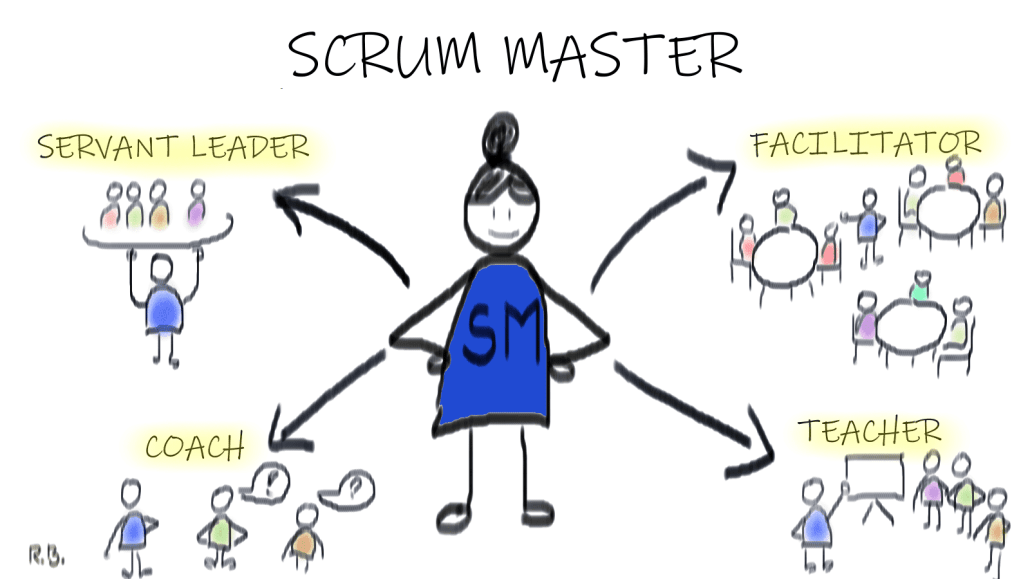
A Scrum Master plays a critical role in the Agile development process, facilitating the Scrum framework and helping the Scrum team (usually a group of software developers) work effectively. While the specific daily tasks of a Scrum Master can vary depending on the team’s needs and the organization’s practices, here are some common activities they typically engage in on a daily basis:

  1. Team Facilitation: The Scrum Master helps the Scrum team stay focused on its goals and facilitates daily stand-up meetings (daily scrum) where team members discuss their progress, plans, and any obstacles.
  2. Removing Obstacles: They work to remove impediments or obstacles that hinder the team’s progress. This might involve liaising with other teams or departments to address issues or finding solutions to technical challenges.
  3. Maintaining the Scrum Process: The Scrum Master ensures that the team follows the Scrum framework’s practices, including sprint planning, sprint review, and sprint retrospective meetings. They help the team stay on track and adhere to timeboxing.
  4. Protecting the Team: Scrum Masters shield the team from external distractions and interruptions, allowing them to focus on the work they’ve committed to during the sprint.
  5. Coaching and Mentoring: Scrum Masters coach team members and the Product Owner on Agile principles and practices, helping them continuously improve their skills and understanding of the process.
  6. Continuous Improvement: They promote a culture of continuous improvement within the team. This includes conducting retrospectives to identify areas for improvement and implementing changes to enhance the team’s performance.
  7. Communication: Scrum Masters facilitate communication within the team and between the team and stakeholders. They ensure that everyone has the information they need to make informed decisions.
  8. Monitoring Progress: Scrum Masters track the team’s progress toward its sprint goals and ensure that work is being completed according to the Definition of Done.
  9. Servant Leadership: They embody the concept of servant leadership by supporting the team’s self-organization, fostering a collaborative environment, and being responsive to the team’s needs.
  10. Documentation: Scrum Masters may also be responsible for maintaining relevant documentation, such as burndown charts, velocity reports, and other metrics that help the team and stakeholders understand the project’s status.
  11. Conflict Resolution: They help resolve conflicts within the team, promoting a positive and collaborative working atmosphere.
  12. Training and Education: Scrum Masters may organize training sessions or workshops to improve team members’ knowledge of Agile and Scrum practices.

It’s important to note that the specific daily activities of a Scrum Master can vary based on the team’s maturity, the organization’s culture, and the unique challenges of a given project. The Scrum Master’s primary goal is to support the team in delivering high-quality products and continuously improving their processes.

Here are some common Scrum Master interview questions along with example answers:

  1. What is Scrum, and how does it differ from other Agile methodologies? Answer: Scrum is an Agile framework that focuses on delivering valuable increments of a product iteratively and incrementally. It differs from other Agile methodologies in its specific roles (Scrum Master, Product Owner, Development Team), events (Sprint, Daily Scrum, Sprint Review, Sprint Retrospective), and artifacts (Product Backlog, Sprint Backlog, Increment).
  2. What are the primary responsibilities of a Scrum Master? Answer: A Scrum Master is responsible for facilitating the Scrum process, ensuring that the Scrum Team understands and follows the Scrum framework, removing impediments, and helping the team continuously improve. They act as a servant-leader, fostering collaboration and communication.
  3. Can you explain the concept of a “Sprint” in Scrum? Answer: A Sprint is a time-boxed iteration in Scrum, typically lasting 2-4 weeks, during which a potentially shippable product increment is created. Sprints provide a fixed timeframe for work and help teams focus on delivering value. At the end of a Sprint, there is a Sprint Review and Retrospective to inspect and adapt.
  4. How do you handle a situation where the Product Owner frequently changes the requirements during a Sprint?Answer: I would engage in a conversation with the Product Owner to understand the reasons behind the changes. If the changes are necessary, I would work with the team to accommodate them within the current Sprint while ensuring the team’s commitment is respected. If the changes are disruptive, I would encourage the Product Owner to add them to the Product Backlog for prioritization in a future Sprint.
  5. How do you help a Scrum Team become self-organizing?Answer: To help a team become self-organizing, I would encourage open communication, foster a culture of trust and respect, and gradually delegate decision-making authority. I would also coach the team in Agile principles and practices, ensuring they have the necessary skills and knowledge to make informed decisions.
  6. What are impediments in Scrum, and how do you address them?Answer: Impediments are obstacles or issues that hinder the progress of the Scrum Team. To address them, I follow a simple process: I identify impediments, prioritize them based on their impact, work with the team to remove or mitigate them, and then track progress. It’s important to document impediments and escalate them when necessary.
  7. Can you explain the difference between Velocity and Burndown charts?Answer: Velocity is a measure of a team’s capacity and is usually represented as the amount of work completed in a Sprint. A Burndown chart, on the other hand, tracks the remaining work in a Sprint over time. Velocity helps in future Sprint planning, while Burndown charts help monitor progress within the current Sprint.
  8. What is a Daily Scrum, and why is it important?Answer: The Daily Scrum is a daily 15-minute meeting where the Scrum Team synchronizes their work. Each team member answers three questions: What did I do yesterday? What will I do today? Are there any impediments? It’s important because it promotes transparency, alignment, and quick identification and resolution of issues.
  9. How do you handle conflicts within the Scrum Team?Answer: I address conflicts by fostering open communication, active listening, and facilitating constructive conversations. I encourage the team to work together to resolve conflicts, and if necessary, I may provide coaching or mediate discussions to reach a mutually agreeable solution.
  10. What is the Definition of Done (DoD), and why is it important?Answer: The Definition of Done is a set of criteria that must be met for a product increment to be considered complete. It’s important because it ensures that everyone on the team has a shared understanding of what “done” means, leading to consistent quality and potentially shippable increments at the end of each Sprint.

Remember that in Scrum Master interviews, it’s not just about providing the correct answers but also demonstrating your practical experience and understanding of Agile and Scrum principles. Be ready to share examples from your past experiences that illustrate how you’ve effectively fulfilled the role of a Scrum Master.

Tag Archive for: scrum

Professional Scrum Master

What is Professional Scrum Master:
The Professional Scrum Master (PSM) session is a practical hands on with true live projects, tools and techniques. It is created and examined by Scrum.org, the home of Scrum. By taking this class, please be assured that the course content, trainers and  the resulting certification is of the highest quality.

Professional Scrum Masters demonstrate knowledge and understanding of Scrum and their ability to apply it in real-world situations. The value of certification is intimately tied to the demonstration of knowledge needed to achieve it. By that measure, the PSM assessments are significantly more valuable than available alternatives for Scrum. And, we strive to ensure that they remain valuable and relevant through frequent inspection and adaptation of the assessment content.

Who can attend
Intending Scrum Masters, Product Owners, Developers, Product and project managers who work with Scrum Teams, or anyone who wants to learn how to add value to an already established career. Please note that this is not just for Scrum Masters.

PSM I is recognized by the  industry as a certification that demonstrates a fundamental level of Scrum mastery. As a PSM I certification holder, you have proven that you understand Scrum as described in the Scrum Guide and how to apply Scrum in Scrum Teams. PSM I holders have a consistent terminology and approach to Scrum.

While attendance is not a prerequisite, there are courses available to help you prepare for the test and gain a stronger understanding of Scrum. Depending on your role, either the Applying Professional Scrum or Professional Scrum Master course is highly recommended.

PSM I includes questions from the following Focus Areas as defined in the Professional Scrum Competencies.

Empiricism, Scrum Values, Scrum Team, Events, Artifacts, Done

Self-Managing Teams, Facilitation, Coaching and Mentoring

Managing Products with Agility:

Forecasting & Release Planning, Product Value, Product Backlog Management, Stakeholders & Customers


Professional Scrum Master (PSM I) training module based on the Scrum Guide from scrum.org:

Session 1: Introduction to Scrum and Agile Principles

  • Overview of Agile principles and values
  • Introduction to the Scrum framework
  • Key roles in Scrum: Scrum Master, Product Owner, Development Team
  • Scrum Events: Sprint, Sprint Planning, Daily Scrum, Sprint Review, Sprint Retrospective
  • The importance of transparency, inspection, and adaptation in Scrum

Session 2: Roles and Responsibilities

  • Detailed exploration of the Scrum Master role
  • Responsibilities and accountabilities of the Product Owner and Development Team
  • How these roles interact and collaborate within the Scrum framework
  • The impact of these roles on the success of Scrum projects

Session 3: Scrum Artifacts

  • Deep dive into Scrum artifacts: Product Backlog, Sprint Backlog, and Increment
  • Understanding the purpose and importance of each artifact
  • Techniques for effective Product Backlog management
  • Definition of Done and its significance in Scrum

Session 4: Scrum Events and Timeboxing

  • In-depth discussion on Sprint Planning, Daily Scrum, Sprint Review, and Sprint Retrospective
  • Timeboxing in Scrum and its impact on the development process
  • Techniques for facilitating and participating in Scrum events
  • Handling common challenges during Scrum events

Session 5: Scrum Values and Culture

  • Exploration of Scrum values: Commitment, Courage, Focus, Openness, and Respect
  • Building a culture of collaboration and continuous improvement
  • Strategies for fostering a Scrum mindset within the team and the organization
  • Addressing challenges in adopting Scrum values

Session 6: Scaling Scrum and Exam Preparation

  • Overview of scaling frameworks (e.g., Nexus, LeSS) for large and complex projects
  • Strategies for scaling Scrum in organizations
  • Tips and resources for preparing for the PSM I exam
  • Practice exams and Q&A session to reinforce learning and address any remaining questions

Each session can be structured as a combination of lecture-style presentations, group discussions, interactive activities, and case studies. Assignments and reading materials from the Scrum Guide can be provided between sessions to reinforce learning. Additionally, incorporating real-world examples and experiences can enhance the practical understanding of Scrum concepts.

Tag Archive for: scrum

{“fields”:{“1”:{“id”:”1″,”type”:”name”,”label”:”Name”,”format”:”first-last”,”description”:””,”required”:”1″,”size”:”medium”,”simple_placeholder”:””,”simple_default”:””,”first_placeholder”:””,”first_default”:””,”middle_placeholder”:””,”middle_default”:””,”last_placeholder”:””,”last_default”:””,”css”:””},”2″:{“id”:”2″,”type”:”email”,”label”:”Email”,”description”:””,”required”:”1″,”size”:”medium”,”placeholder”:””,”confirmation_placeholder”:””,”default_value”:false,”filter_type”:””,”allowlist”:””,”denylist”:””,”css”:””},”8″:{“id”:”8″,”type”:”number”,”label”:”Telephone Number”,”description”:””,”size”:”medium”,”placeholder”:””,”default_value”:””,”css”:””},”4″:{“id”:”4″,”type”:”checkbox”,”label”:”Which sessions do you plan on attending?”,”choices”:{“1”:{“label”:”Session 1 – Friday “,”value”:””,”image”:””,”icon”:”face-smile”,”icon_style”:”regular”},”2″:{“label”:”Session 2 – Saturday”,”value”:””,”image”:””,”icon”:”face-smile”,”icon_style”:”regular”}},”choices_images_style”:”modern”,”choices_icons_color”:”#0399ed”,”choices_icons_size”:”large”,”choices_icons_style”:”default”,”description”:””,”required”:”1″,”input_columns”:””,”choice_limit”:””,”dynamic_choices”:””,”css”:””},”6″:{“id”:”6″,”type”:”checkbox”,”label”:”Stay in touch !”,”choices”:{“1”:{“label”:”I would like to receive email updates regarding future conferences”,”value”:””,”image”:””,”icon”:”face-smile”,”icon_style”:”regular”}},”choices_images_style”:”modern”,”choices_icons_color”:”#0399ed”,”choices_icons_size”:”large”,”choices_icons_style”:”default”,”description”:””,”input_columns”:””,”choice_limit”:””,”dynamic_choices”:””,”css”:””},”7″:{“id”:”7″,”type”:”textarea”,”label”:”Comments or Questions”,”description”:””,”size”:”medium”,”placeholder”:””,”limit_count”:”1″,”limit_mode”:”characters”,”default_value”:””,”css”:””}},”id”:”844″,”field_id”:9,”settings”:{“form_title”:”Webinar Free – Project Manager & Scrum Master 1″,”form_desc”:””,”submit_text”:”Submit”,”submit_text_processing”:”Sending…”,”form_class”:””,”submit_class”:””,”ajax_submit”:”1″,”notification_enable”:”1″,”notifications”:{“1”:{“email”:”{admin_email}”,”subject”:”New Entry: Webinar Free – Project Manager & Scrum Master 1″,”sender_name”:”Live Project Management Training”,”sender_address”:”{admin_email}”,”replyto”:”{field_id=\”2\”}”,”message”:”{all_fields}”}},”confirmations”:{“1”:{“type”:”message”,”message”:”

Thanks for contacting us! We will be in touch with you shortly.<\/p>“,”message_scroll”:”1″,”page”:”2″,”redirect”:””}},”antispam”:”1″,”form_tags”:[]},”meta”:{“template”:”be32b8cc1eb80419086b4b282acf6d4b”}}

Tag Archive for: scrum